|
 |
|
| Campbell's Liquid Gold is intense, rich and luscious with hints of candied peel and cold tea. This wine is made using the solera system – a wood-ageing method of fractional blending; the concentration of flavours is partly due to the evaporation, an important element in the process. Campbells» |
|
| Previous vintages have claimed Trophy Citadelles du Vin France and multi Gold Montreal, Singapore, UK, Russia & Japan. A wine with exuberant aromas of gooseberry, grapefruit and pineapple, complimented by rich flavours, impressive weight and excellent length.. Gravitas» |
|
| Named for the chapel district of Lenton in Nottingham, Brae is Scottish for a small hill, which is what the Lenton Brae vineyard is situated on. Fortuitously placed within the very epicenter for superior Margaret River Cabernet, the site was planted after advisement from the proprietors of nearby Moss Wood, with which it shares a similar terroir and microclime. Lenton Brae» |
|
| Elderton know what it takes to make Australia's best Cabernet Sauvignon, having claimed multiple trophies including the 1993 Jimmy Watson. The Ashmead block has consistently produced small parcels of outstanding quality fruit. Elderton» |
|
| Excellent Langtons Classification. A multiple trophy and gold winner at national and international wine shows. Wynns» |
|
| Like an uncut diamond, the Chardonnay grape lends its sparkle to the Ruinart wines. In the constant pursuit of perfection, the Ruinart House excels in the art of handling this very special grape variety. Ruinart» |
|
| Gold Medal Los Angeles, Gold Decanter World Wine Awards London, Wine & Spirits International Wineries of the Year Awards. Those who are lucky enough to experience Chambers Rosewood, say that the wines leave indelible memories.. Chambers Rosewood» |
|
| Leconfield's highly cherished flagship has been in fine form for years. Vintage 2006 won South Australian Cabernet of the Year at the Advertiser Hyatt Awards and Trophy at the prestigious London International. Leconfield» |
|
| Shadowfax has progressed from strength to strength in a very short space of time, due in no small part to the high quality of fruit. A prolific trophy and gold winner, Shadowfax have achieved the new wave of Chardonnay, refreshingly fruit driven, livelier than it's stylistic prescursors, characterised by slatey, flavoursome acidity, a touch of leesy complexity and a pleasing dryness. Shadowfax» |
|
| David O'Leary and Nick Walker amassed over three hundred gold medals and sixty trophies between them, including the prestigious Jimmy Watson. A shared confidence in the quality of Clare Valley fruit was the catalyst for them to establish their own winery. OLeary Walker» |
|
| Grange combines the intensity of superior Shiraz fruit, with the complementary nuances of new fine-grained American oak. The 1965 Grange, plainly labelled as Penfolds Claret won the coveted Jimmy Watson Trophy, awarded to the best one-year-old red, the 1967 Grange won the same trophy two years later. Penfolds» |
|
| Rouge Homme evoke fond memories of the enduring Aussie claret style. The winemaking team, as custodians of Rouge Homme's illustrious heritage, continue to fashion a rich and approachable Cabernet Sauvignon with balance, structure and style. Rouge Homme» |
|
Austins
About Austins - the Winery
Austins
Richard and Pam Austin began their journey with wine 27 years ago with a five-acre vineyard, in Geelong, dedicated to making super premium wines for Australia’s best restaurants
The Austins planted their first vines in the Barrabool Hills, southwest of Geelong, in the early 1980s. The soil they turned was the same worked by the pioneering Swiss more than a century before. During it's nineteenth century heyday, the Geelong region was recognised as producing some of the finest red wines made in Australia's first one hundred years. This was at a time when the Victorian wine industry out-produced the sum of the South Australian and New South wales industries by a factor of two. The area suffered badly in the second half of the nineteenth century when phylloxera (a grapevine pest) and bureaucracy combined to destroy the region. The Moorabool Valley re-emerged in the first days of the Victorian wine industry's renaissance, in the 1960s. Recognition of that link has played a major part in the Austin family's affair with wine and the move to Sutherlands Creek.
In the 1990s, the family purchased a large property near Bannockburn, in the Geelong region. Richard Austin set about planting of 150 acres of vines with the single-minded focus of producing the best value Pinot Noir in the world. One of the great challenges in modern winemaking is to consistently produce Burgundian-style Pinot Noir at an affordable price. The success of that determination, in achieving a pinot noir for the people, comes down to the acumen and persistence of the Austins family, an expertise well-honed in the corporate world and a love and understanding of the wine and food. Richard Austin propagated the business plan and planted the vines. Pam Austin drove sales and, more recently, their son Scott Austin assumed control of the company and took Austins to the rest of the world.
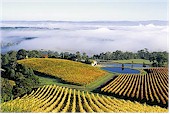
The climate, the rolling slopes of this part of the Moorabool Valley and the soil combine in a terroir that supports the vines with first-class fruit the result. Terroir is all important. The world's best wines are made from the world's best vineyards. The pinot noir produced by Austins argues consistency of style and quality. The fruit and, thereby, the wine has a distinct point of difference with its peers. That difference impacts your senses - you can smell it and taste it.
The premium quality, of the pinot noir, is augmented by the mix of six clones throughout the vineyard. Austins vineyard, at Sutherlands Creek, includes one of the largest, family-owned holdings of Pinot Noir in Australia. The property also has small plantings of riesling, chardonnay, pinot gris, viognier and shiraz, all of which produce exceptional fruit in the cool climate conditions of the Moorabool Valley, a sub-region of Geelong.
Austins is situated in the heart of the Moorabool Valley, a sub-region of Geelong. Though one of Australia’s most recently recognised sub-regions, the Moorabool Valley can trace its wine industry roots back to the early 1840s, when Swiss immigrants began planting vines. These were some of the earliest plantings in Victoria.
Today, the Moorabool Valley produces high quality fruit for both white and red wine. In terms of style, these wines sit between those from the Yarra Valley and the Mornington Peninsula. It is a region of great promise and one that can harness the generosity of the Australian circumstance and offer wines of grace and finesse. Bounded by the vineyard at Sutherlands Creek and based on the history of the Geelong region, that core is shaped by the terroir of the site and given momentum by the perception and acumen of the Austin family. The blend of these elements transforms premium grapes into wines of finesse. Great pinot noir is perfection. For those who enjoy making it and those who want to pour another glass, pinot noir is the ultimate example of less is more, in the world of red wine. This growing band of supporters sees a wine that offers extraordinary detail and complexity within a fine and restrained package; while the impact on the senses can be immense, the touch is light.
There is growing diversity in the style of pinot noir. While the Australian genre is restricted to the cooler climes, there are subtle differences in fruit profile, generosity and tannin structure to be found. Internationally, the range is greater. Pinot noir from Austins sits easily amongst its peers though it has one significant difference. Within aroma and flavour profiles, both Austins and sixfootsix pinot noirs offer a distinct suggestion of spice that sets them apart. It is this reflection of terroir that lifts both wines above the pack - and closer to perfection.
|
|